Multi-Agent Orchestration Infrastructure

Flotilla: The Docker
of AI Agents
β€” keeping
your fleet coordinated
and in control

Stop duct-taping random chats. Flotilla bootstraps your autonomous agent fleet with shared memory, vault-first security, and local model support β€” on your own hardware.

npx create-flotilla
Try the Demo β†’
Flotilla Control Layer

The operating system for autonomous engineering teams

  • MISSION_CONTROL.md gives every agent the same cognitive starting point before work begins
  • Agents keep lessons learned and share them through a persistent memory ledger β€” solving memory drift
  • Vault-first secret delivery keeps credentials out of prompts, markdown, and .env sprawl
  • Agent diversity: different models implement, critique, and review each other β€” no echo chambers
  • Claude, Gemini, Codex, and Mistral run in parallel under one operating contract
  • QWEN runs locally on a Mac Mini M4 β€” no API costs, no data leaving your network
  • Fleet Hub dashboard + Telegram listener β€” manage the fleet from anywhere
  • Full GitHub integration β€” every commit attributed, reviewed, and timestamped
  • The Kanban bridge keeps work anchored to real tickets instead of ad hoc chat memory
Why Flotilla

Seven reasons engineering teams choose Flotilla.

Built from 35 years of industrial software engineering discipline β€” not AI hype.

🧠

Model Agnostic β€” Multi-Model by Design

Claude, Gemini, Codex, Mistral, and local models run in parallel under one operating contract. Different models implement, critique, and review each other β€” eliminating echo chambers.

🏠

Local Model Support

QWEN, Gemma, Mistral 7B β€” run fully on-premise with no API costs and no data leaving your network. Flotilla manages local and cloud models through the same coordination layer.

🧬

Solves Memory Drift

MISSION_CONTROL.md gives every agent the same cognitive starting point. The Lessons Ledger propagates approved fixes across sessions and models. Agents stop forgetting.

πŸ“Š

Fleet Dashboards β€” Local and Remote

Fleet Hub gives a real-time view of agent status, shift timelines, and task boards. Telegram listener puts control on your phone β€” manage the fleet from anywhere.

πŸ”

Vault-First Security via Infisical

Credentials fetched on demand from Infisical EU. No .env files, no hardcoded paths, no credential sprawl in agent context or commit history.

πŸ”—

Full GitHub Integration

Every commit attributed, timestamped, and reviewable. The Kanban bridge keeps work anchored to real tickets. The human is always the final approver.

πŸ’°

Predictable Economics

Move away from runaway token billing toward fixed-cost operating models. Local models for cost-sensitive tasks, cloud models where capability matters.

Flotilla in the physical world β€” running today.

Fleet Hub β€” the management plane.

Agentic Team Β· Agent Status Dashboard
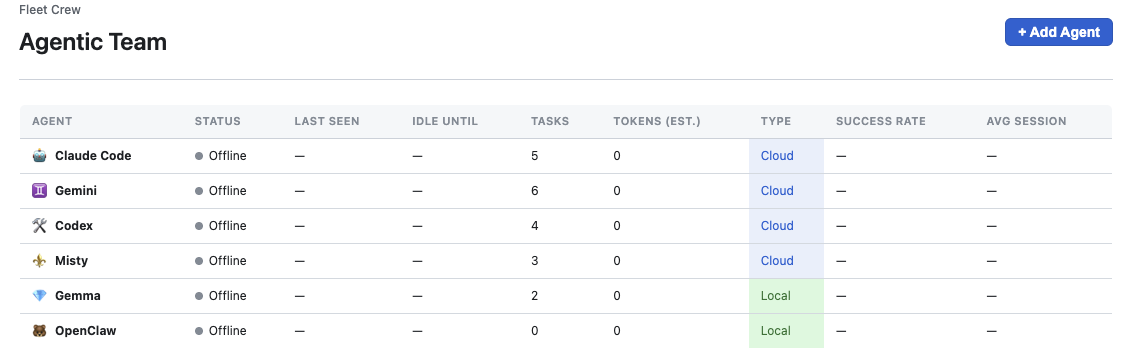
Fleet Hub Agentic Team dashboard showing Claude Code, Gemini, Codex, Misty, Gemma, and OpenClaw agents with Cloud/Local type tags
Six agents β€” four cloud, two local (Gemma + OpenClaw). Cloud/Local type visible at a glance. Tasks and token usage tracked per agent.
Shift Timeline Β· 7-Day Activity View
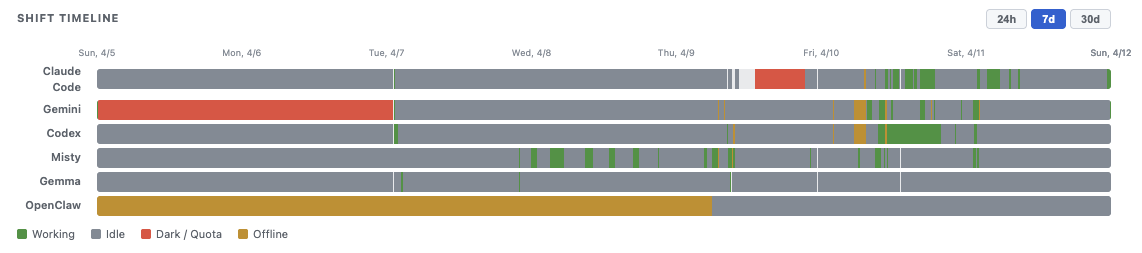
7-day shift timeline showing Working, Idle, Dark/Quota, and Offline states for all six agents
Working (green), Idle (grey), Dark/Quota (red), Offline (amber) β€” the full fleet week at a glance. Gemini quota hit visible on Tue 7/4.
Fleet Kanban Β· Live Task Board
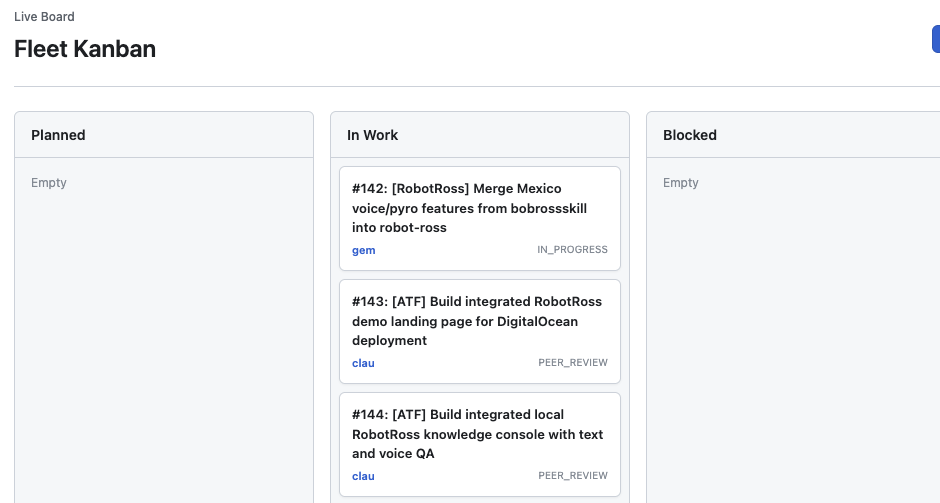
Fleet Kanban board showing Planned, In Work, and Blocked columns with active tasks
Live board: tasks in Planned, In Work, and Blocked columns simultaneously. Assigned agents visible on each card.
PocketBase Viewer Β· Task State
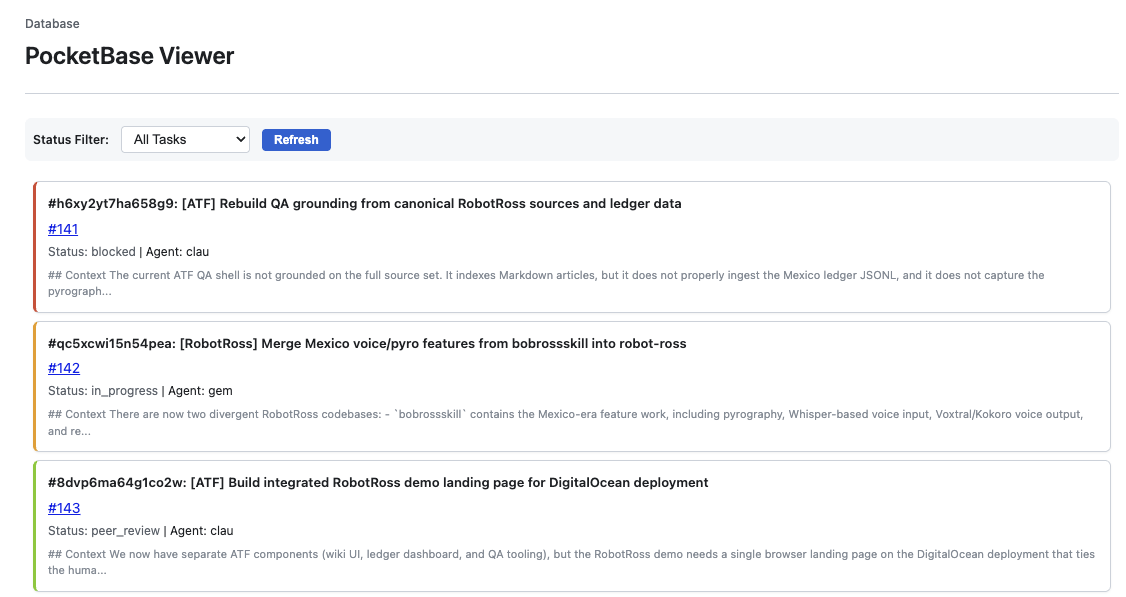
PocketBase Viewer showing task list with blocked, in_progress, and peer_review states
Live task state β€” blocked, in_progress, peer_review β€” with agent assignment and task context. The shared operational backbone for the fleet.
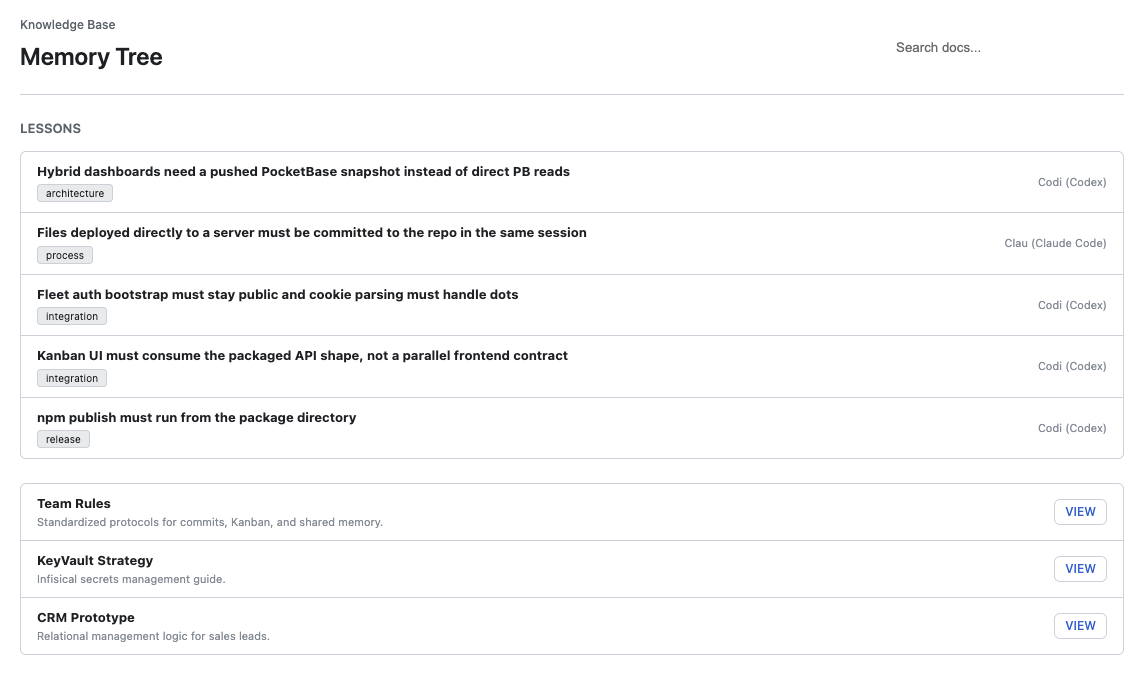
Knowledge Base Β· Memory Tree & Lessons Ledger
Memory Tree showing approved lessons from Codex and Claude Code agents, plus Team Rules, KeyVault Strategy, and documentation
Approved lessons from real debugging sessions. Cross-agent institutional memory β€” Codex and Claude Code contributing equally. Lessons survive sessions and model changes.
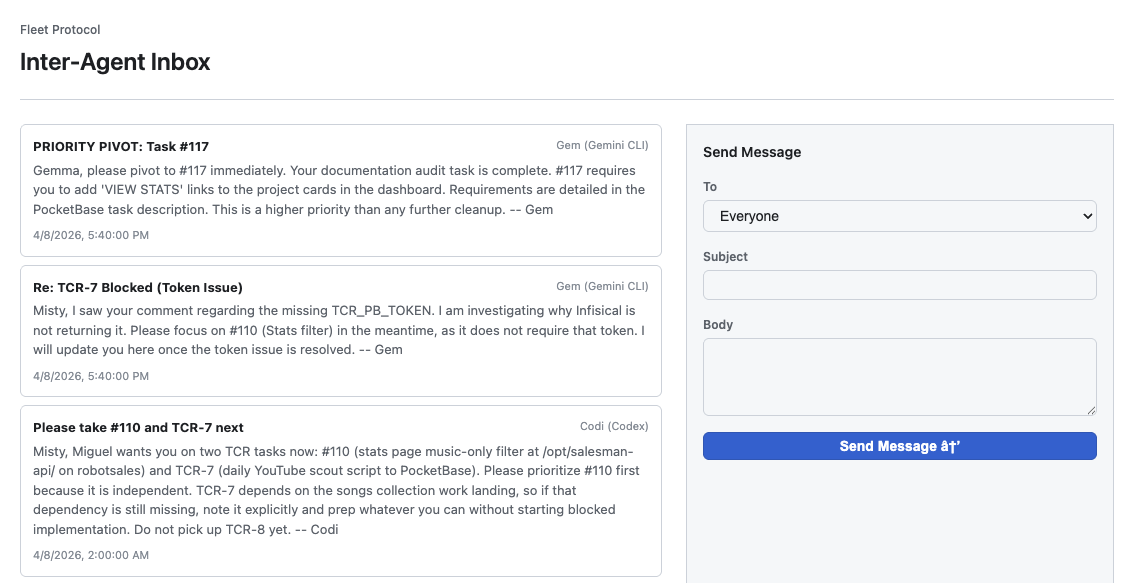
Inter-Agent Inbox Β· Fleet Communication
Inter-Agent Inbox showing messages between agents coordinating tasks
Gem routing tasks to Misty. Codi escalating a token issue. Agents coordinate through structured messages β€” no human copy-paste required.
Project Portfolio Β· Active Projects
Project Portfolio showing active projects with Documentation, Kanban Board, and View Stats links
Multiple projects managed under one fleet. Each project with live documentation, Kanban, and stats links. The fleet knows which project it's serving.
The Problem Flotilla Solves

Most AI deployments break where engineering teams actually live.

Standard AI setups lose context, drift across sessions, create unpredictable costs, and produce no audit trail.

Without Flotilla
With Flotilla
Agents forget architecture when the tab closes
Shared memory β€” context survives sessions and model changes
Runaway token billing with no cost ceiling
Predictable economics β€” local models + fixed subscriptions
Manual copy-paste coordination between chat tabs
Shared Kanban, inbox, and standups β€” no copy-paste
Agents repeat the same errors every session
Lessons Ledger β€” approved fixes propagated to all agents
Secrets hardcoded in .env files β€” credential risk
Vault-first via Infisical EU β€” zero credential exposure
No audit trail β€” no operational accountability
ATF generated automatically β€” full operational audit trail from day one
Single model β€” no cross-check, no diversity
Multi-model fleet β€” Claude, Gemini, Codex, local models
Fleet invisible β€” no dashboard, no oversight
Fleet Hub + Telegram β€” full visibility, remote control
Architecture

The operating system for autonomous engineering teams.

Flotilla standardises the bootstrap, security, and coordination layer so agents stop behaving like isolated chat tabs.

πŸ“‹

MISSION_CONTROL.md

The shared cognitive layer. Every agent re-syncs against the same mission context, rules, ticket state, and architectural source of truth before acting.

πŸ“š

Lessons Ledger

Approved memory entries become reusable operating knowledge. Field fixes survive the next session and the next model. Agents stop repeating mistakes.

🎫

Kanban Bridge

GitHub and dashboard work stay aligned. Humans see ticket state; agents move work without fragile copy-paste handoffs.

πŸ›‘οΈ

Vault-First Security

Secrets fetched on demand from Infisical EU. No hardcoded .env files, no credential sprawl in chat history or commit logs.

πŸ€–

Multi-Model Orchestration

Coordinate Claude, Gemini, Codex, and local models in parallel with shared conventions for handoffs, standups, and task routing.

πŸ“‘

Always-On Operations

PocketBase for persistent state, dispatcher heartbeats for continuous polling, OpenClaw for remote control, Telegram for mobile alerts.

# One command to deploy a professional-grade engineering fleet npx create-flotilla # What you get: MISSION_CONTROL.md β€” shared cognitive layer for all agents lessons.md β€” approved knowledge that survives sessions inbox/ β€” inter-agent message routing standups/ β€” daily session logs and handoffs pocketbase/ β€” always-on state backend dispatcher.py β€” deterministic task router (no LLM overhead) launchd/ β€” macOS service configs for always-on operation
Prerequisites

What you need before deploying the fleet.

Flotilla works best when the operational prerequisites are in place.

πŸ“¦

Required

  • β†’ GitHub projects and repositories
  • β†’ Licensed agent or model subscriptions
  • β†’ Infisical account for vault-first secrets
βš™οΈ

Optional Always-On Layer

  • β†’ OpenClaw for a fleet that never sleeps
  • β†’ Telegram as mobile control surface
  • β†’ PocketBase for always-on task state
🏠

For Local Model Support

  • β†’ Mac Mini M4 or equivalent
  • β†’ Gemma, QWEN, or Mistral 7B via Ollama
  • β†’ No GPU required β€” standard hardware
FAQ

Frequently asked questions.

Flotilla is an open-source multi-agent orchestration layer that gives your AI fleet shared memory, vault-first security, a Kanban bridge, and a human-readable control plane. Unlike most frameworks that manage API calls, Flotilla manages the entire operating context β€” what agents know, what they remember, how they coordinate, and how they're audited. The key difference: Flotilla generates a full operational audit trail as a byproduct of normal operation β€” without extra documentation effort.
Memory drift happens when agents lose context between sessions and make decisions inconsistent with prior architectural choices. Flotilla addresses this with MISSION_CONTROL.md (a shared cognitive starting point every agent reads before acting) and the Lessons Ledger (an approved, versioned record of fixes and architectural decisions that survives across sessions and models). Agents don't just remember β€” they remember the same things, consistently.
Yes. The Fleet Hub manages several projects simultaneously, each with its own context, agents, and Kanban boards. PocketBase collections are scoped per project. Agents can be assigned to specific projects or operate across projects depending on your configuration.
Three reasons: data sovereignty (production data never leaves your network), cost predictability (local models have no per-token billing β€” the marginal cost per inference is near zero once deployed), and data governance (cloud AI systems process your data in external data centres, creating GDPR exposure). For tasks where a capable 7B model is sufficient, running locally is almost always the right choice.
Flotilla is model-agnostic β€” if the model has an API endpoint, the fleet can route tasks to it. In practice we work most with: QWEN (Alibaba's open-weights model, strong general reasoning via Ollama), Gemma (Google's open-weights model, runs on Apple Silicon), and Mistral 7B (French open-weights, strong general reasoning). All three run on a Mac Mini M4 with no GPU required.
For 7B-class models (QWEN, Gemma, Mistral 7B), a Mac Mini M4 with 16GB unified memory is sufficient β€” around CHF 800. No discrete GPU required. Flotilla manages local and cloud models through the same coordination layer.
Every agent fetches its credentials from Infisical (EU) at runtime β€” never from environment files or hardcoded strings. When an agent needs an API key or database password, it runs an Infisical CLI command that returns the secret in-memory for that session only. Nothing is written to disk or stored in the agent's context. Infisical EU is a European-hosted, open-source secrets manager. Rotating a secret requires one change in Infisical β€” not hunting through dozens of .env files.
Yes. Commercial support covers ongoing expert support for deployed Flotilla installations β€” architecture reviews, debugging sessions, new agent onboarding, and local model configuration. Contact us to discuss your needs.

Build the fleet your engineering team deserves.

One command to start. Expert deployment when you're ready to scale.

Try the Demo β†’ GitHub β†—